 MetaStocker
Portfolio SEO
How to Measure Results from a Stock Photography Blog
A stock photography blog can support contributors in several ways: it may appear in Google results, attract visits, help readers solve a metadata problem, or lead them to try a generator. These are related outcomes, but they are not the same measurement. A page can gain impressions without clicks, receive visits without producing generator use, or help readers while remaining too small to show a clear search trend.
The practical approach is to define each outcome separately, compare equivalent periods, and interpret the numbers with appropriate caution. This guide uses a hypothetical article about preparing English metadata for a food photograph. The example is not a measured result or a real customer case. It shows how a contributor or publisher can build a useful review routine without pretending that analytics identify every person or prove sales.
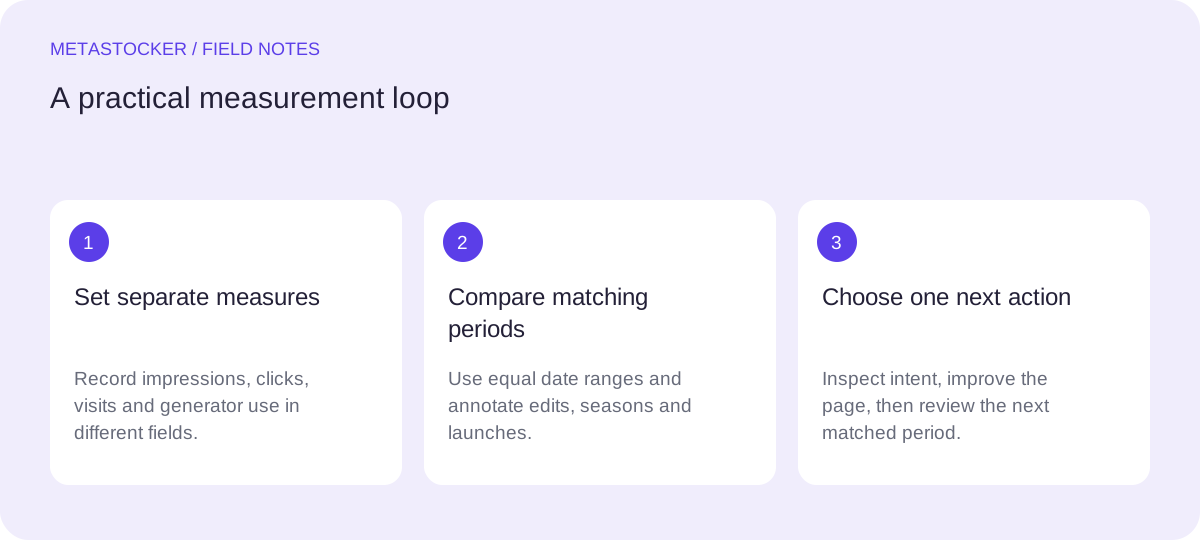
1. Define the outcome before checking numbers
Write down the question your article is meant to answer. For search visibility, ask whether the page is appearing for relevant queries. For engagement, ask whether people are clicking through and visiting the article. For product interest, ask whether visitors use the local generator after reading it.
Keep the measures in separate columns. Search impressions and clicks describe search exposure. Article visits describe behavior on your website. Generator use describes an action in the product. None of these alone proves a marketplace download, a sale, or a ranking improvement.
- Visibility: impressions and clicks for the article or query group.
- Engagement: article visits and, where available, meaningful return actions.
- Product interest: generator-use events, counted separately from visits.
2. Compare like periods
Choose two periods with comparable length and context, such as 1–30 September and 1–30 August. Avoid comparing a partial month with a complete month. Record publication date, major edits, translation launches, seasonal campaigns, and any technical changes that could affect interpretation.
Use the same page set and query definition in both periods. A broader keyword filter in the second period can create an apparent improvement that is really a measurement change. If the page is new, label the first comparison as an early baseline rather than a trend.
- Match calendar length and, when relevant, weekday composition.
- Separate new articles from established articles.
- Annotate substantial edits and language-version launches.
3. Read impressions and clicks together
Impressions indicate that a search result was shown; clicks indicate that someone selected it. Rising impressions with flat clicks may mean the topic is being discovered but the title or result wording is not compelling for that audience. Falling impressions with a stable click rate may indicate reduced exposure rather than a content-quality problem.
Treat these as website search measurements, not internal stock marketplace search data. They also do not guarantee crawling, indexing, ranking, traffic, or revenue. Improve the page for people first: answer the stated question, explain decisions, and use descriptive text around relevant images.
- Group related queries before drawing conclusions.
- Inspect the actual query wording before changing the article.
- Do not turn a short-term movement into a ranking claim.
4. Connect article visits to useful actions
Once someone reaches the article, examine visits separately from search performance. A visitor may arrive through a search result, a translation, a social post, or another page. Compare the number of article visits with generator-use events for the same period, but do not treat the totals as a person-by-person journey.
A local generator can keep photos, prompts, and results on the visitor’s device during local use. Its minimal first-party aggregate analytics do not provide a permanent visitor ID, so you cannot reliably attribute repeated actions to one unique person. Report counts as aggregate activity, not unique users.
- Keep article visits and generator-use events in different metrics.
- Describe local processing accurately; model inference remains on the visitor’s device.
- Avoid claims such as “every visitor generated metadata.”
5. Worked example: decide what to change
Example: you publish “English Metadata for a Homemade Pasta Photo.” In the next matched 30-day comparison, impressions increase while clicks change little. Article visits are steady, and generator-use events are present but not clearly attributable to individual readers.
Your first decision should be editorial, not promotional. Inspect the search queries and opening paragraph. If readers are looking for title structure and keyword order, make those answers visible near the beginning. Add a concrete metadata example, explain why “fresh pasta” is relevant while an unrelated location is not, and use descriptive alt text for the website image. Then record the edit date and wait for a new like-for-like period.
Do not conclude that the generator caused the search change, that the article produced sales, or that a particular person used it. The evidence supports a narrower conclusion: the page had a change in visibility, clicks, visits, and aggregate generator activity that should be reviewed separately.
- Baseline: record each metric and its date range.
- Diagnosis: inspect query intent and page usefulness.
- Action: make one clearly documented editorial change.
- Review: compare the next equivalent period.
Example metadata for a pasta photograph:
Title: Homemade fresh pasta dough on a wooden table
Keywords: fresh pasta, pasta dough, homemade food, cooking, ingredients, kitchen, Italian food, food preparation
Reasoning: describe what is visible and relevant; do not add a guessed person, location, or story.
6. Use the results to plan the next article
A useful review ends with a decision. Keep an article when it answers a recurring question and remains accurate. Revise it when visitors arrive with a clear unanswered intent. Create a companion article when impressions reveal a related question that deserves its own explanation.
If you publish Russian and English versions, treat each language URL as its own editorial and measurement unit. A Russian article does not automatically require Russian marketplace metadata; show English metadata when the target platform requires it, and explain the choice. Check current contributor-portal policies before relying on platform limits or upload rules.
- Keep: the page is useful and the intent still matches.
- Revise: queries or visits reveal a specific gap.
- Extend: a related question deserves a separate page.
- Recheck: marketplace requirements can change.
Before you continue
- Define visibility, article visits, and generator use as separate outcomes.
- Compare complete, equivalent periods and document important changes.
- Inspect query intent before editing titles or content.
- Use descriptive, people-first website text and image alt text.
- Report generator activity as aggregate counts, not unique-person attribution.
- Label examples as hypothetical and avoid claims about sales or rankings.
- Review current contributor-portal requirements before publishing platform-specific guidance.
Sources and editorial approach
Prepared with AI assistance. Worked examples are illustrative. Automated checks do not replace checking the requirements of your stock platform. How these guides are made.