 MetaStocker
Local AI
How to Compare Local AI, Paid APIs, and Manual Keywords
Choosing a metadata method is less about finding a universal winner and more about matching a workflow to your files, privacy needs, and tolerance for editing. A local generator may keep photos and prompts in the browser, a paid API may offer another drafting option, and manual keywording gives you direct control. None should be judged by model league tables or promises of sales. Test the methods on the same small set, record what went wrong, and choose the process that produces accurate, editable metadata for your portfolio.
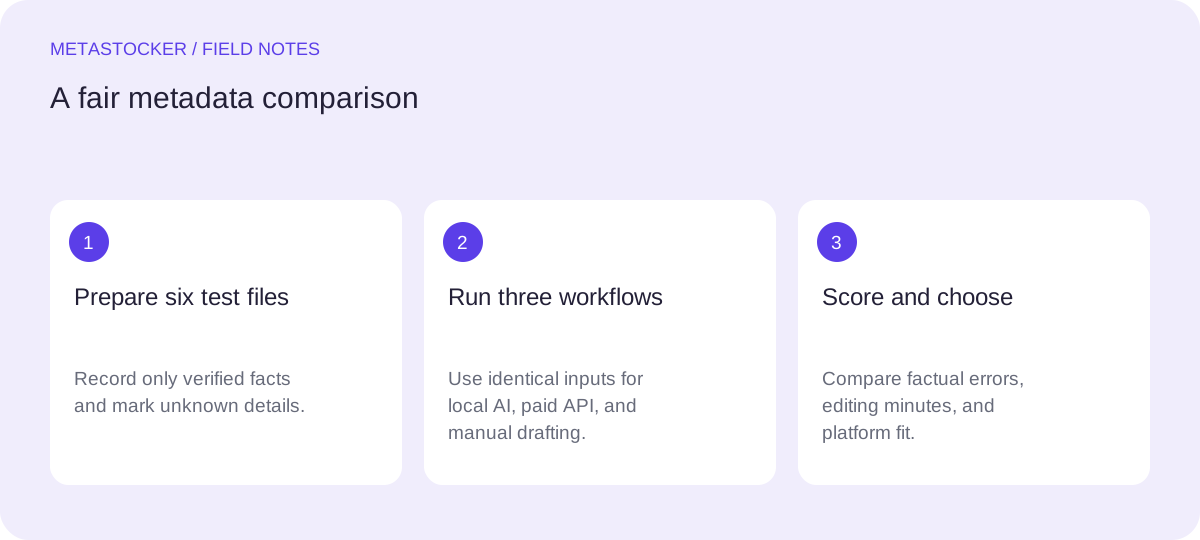
Define the comparison before generating anything
Use six assets that represent different reasoning problems rather than six similar photographs. For example, choose a simple object still life, a landscape with uncertain location, a person whose identity must not be guessed, a food image, a busy commercial scene, and a short video. Keep the original filenames and prepare the same factual notes for every method.
Decide in advance what counts as an error. An invented location, species, date, brand, identity, action, or visible object is factual. An irrelevant keyword, duplicate, unsupported technical claim, or keyword in the wrong language is also a quality problem. Do not count a missing optional synonym as a factual error.
- Use identical source images and factual notes.
- Keep the target platform and language consistent.
- Record editing time with a simple timer.
- Treat all examples as tests, not measured industry results.
Build a repeatable six-asset test set
Make a small worksheet with one row per file. Record only what you can verify: visible subject, broad setting, orientation, activity, and any information known from your own records. Mark unknown details explicitly. This prevents a system from receiving hidden advantages from extra notes.
For a video, compare metadata with sampled previews but inspect the full motion yourself. A sampled preview can miss a later action, transition, or object. For a person, use a neutral description such as “adult person” unless you have an appropriate basis for more detail. Do not infer personal identity, ownership, release status, location, or species from pixels.
- Object still life
- Landscape with unknown location
- Person without identity claims
- Food or preparation scene
- Busy commercial composition
- Short video requiring full-motion review
Test worksheet
File: market-bowl.jpg
Verified: ceramic bowl, oranges, wooden table, daylight
Unknown: city, photographer, brand, exact date
Required language: English
Target: descriptive title plus relevant keywords
Test local AI with controlled settings
MetaStocker’s local mode runs supported vision and thinking models in WebGPU workers in your browser. The default local model is Gemma 4 E2B, with Gemma 4 E4B and Qwen3.5 2B also available. Downloading a model needs internet; after that, the model is loaded into memory when you explicitly choose Load.
For a fair comparison, begin with one local thread and the same prompt for all six files. A second parallel thread can be tested later, but each thread may load its own model copy. Do not confuse a retained browser cache with active model memory: unloading can retain downloaded files while releasing the model from memory, and browser storage can be evicted.
Give the batch description only verified context. A mixed batch should not receive blanket tags that fit one image but not another. Review every file’s editable result, especially extra tags and video descriptions. The requested tag count can be validated while the content remains inaccurate.
- Download once, then record whether the model is loaded.
- Use one thread for the baseline.
- Remove speculative tags before scoring.
- Delete browser model files only after the comparison is complete if you may need them again.
Compare a paid API and manual keywording fairly
For the paid API condition, use the same six assets, notes, output language, target platform, and requested field structure. Record the time spent preparing the request and correcting the result, not just the generation time. If using MetaStocker’s optional personal OpenAI mode, previews and context are sent to OpenAI using your own key. Keep the key private; never place it in public client-side code or share it.
For manual keywording, work from the same worksheet and use a fixed maximum working time, such as 12 minutes per image in this hypothetical test. Manual work is not automatically error-free: hurried contributors can add irrelevant terms or forget important visible concepts. Score it with exactly the same rules as the AI outputs.
- Local AI: record setup, editing, and review time.
- Paid API: include request preparation and correction time.
- Manual: include research-free drafting and final review.
- Do not compare one polished result with another method’s raw draft.
Use an error-and-time scorecard
A useful scorecard has two primary columns: factual errors and editing minutes. Add secondary notes for missing important concepts, irrelevant tags, duplicates, language mismatches, and uncertainty. Keep factual errors separate from style preferences. A concise title may be better than a longer one even when both are accurate.
For platform metadata, verify the current contributor rules before exporting. Adobe’s guidance allows up to 49 keywords and emphasizes the most important terms early; its CSV requirements also map filenames to titles and keywords. Use a conservative 49-keyword ceiling, check the current upload screen, and inspect imported metadata in the contributor portal. Uploading assets before a CSV import and matching filenames, including extensions and case, are part of that workflow. A CSV does not guarantee acceptance.
- Factual errors: count unsupported claims.
- Editing time: record minutes per file.
- Relevance: mark irrelevant or repeated terms.
- Completeness: note important concepts that are missing.
- Compliance: check current platform requirements separately.
Scorecard example
Method: local AI
Factual errors: 2
Editing minutes: 7
Other notes: one duplicate keyword; location correctly left unknown
Decision: usable draft after removing two speculative terms
Worked example: make the decision from evidence
Example, not a measured result: imagine the market-bowl.jpg row produces a title mentioning a city that was never supplied, plus “organic” and “fresh” as if they were verified facts. Remove the city and any unsupported claim, retain accurate terms such as bowl, oranges, wooden table, and daylight, then record three factual errors and the minutes required for correction.
Suppose the paid API produces a fluent title but adds a brand implication, while manual keywording is accurate but takes longer. The decision is not “AI wins” or “manual wins.” It might be to use local AI for first drafts of ordinary still lifes, manual review for every file, and a separate careful process for people and video. If the local model repeatedly invents details on your test set, its privacy advantage may not compensate for the editing burden.
If the target marketplace requires English metadata, write or translate the final title and keywords in English even when your working notes or this guide are in Russian. Keep the wording descriptive rather than stuffing a list of search terms into a title. Marketplace search metadata is separate from Google website indexing; neither method guarantees ranking, visibility, or sales.
- Choose the method per file type if the evidence supports it.
- Keep unknown facts unknown.
- Export only rows you have reviewed.
- Recheck portal rules when requirements change.
Before you continue
- Prepare six deliberately different files and one factual worksheet.
- Run local AI, paid API, and manual methods on identical inputs.
- Count factual errors using rules written before the test.
- Time editing and review, not only draft generation.
- Inspect people, brands, locations, species, releases, and full video motion.
- Use English metadata when the target marketplace requires it.
- Check current contributor requirements before CSV export or upload.
- Keep API keys private and review every editable result.
Sources and editorial approach
Prepared with AI assistance. Worked examples are illustrative. Automated checks do not replace checking the requirements of your stock platform. How these guides are made.