 MetaStocker
Titles & keywords
How to Keyword Night Photos with Precision
Night photographs can look simple but create a metadata trap: a few bright lamps and reflected light may suggest a story that the frame does not prove. Precise keywords should describe what is visible, preserve useful search language, and avoid invented events, people, locations, weather, or ownership. This guide uses one hypothetical street scene throughout. It is an example, not a measured result or a real customer submission. The goal is a repeatable workflow for a contributor preparing English metadata for a stock marketplace.
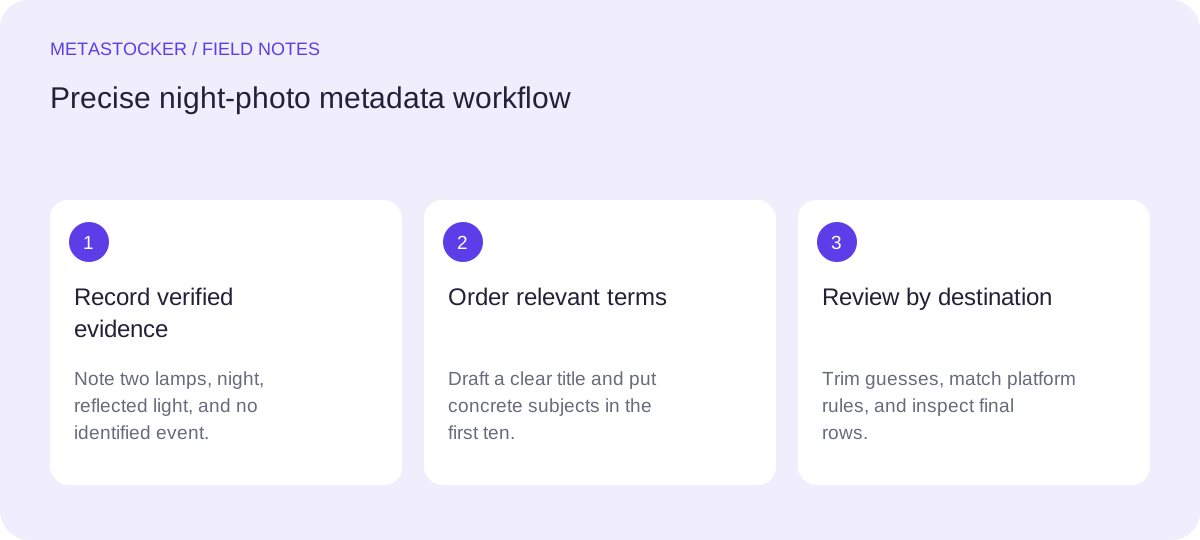
Start with shoot notes, not assumptions
Before writing a title or keyword list, record the photographer’s nonvisual facts separately from observations. For this worked example, the shoot notes say: “Two street lamps are visible at night. Their light appears as reflections on a dark ground surface. No event, named place, person, business, or landmark is identified.” Those notes are the permitted evidence for the example.
The image itself may show a night setting, lamps, light, darkness, and reflections. It does not establish a festival, nightlife, rain, a city, a particular country, or a commercial owner. Treating an attractive interpretation as a fact can make metadata less accurate and less useful.
- Write confirmed shoot notes before drafting metadata.
- Separate visible objects from mood or possible context.
- Leave out identities, locations, events, and ownership unless verified.
Choose a precise title
A title should read like a short description, not a pile of search terms. Put the main subject and setting near the beginning, then add the visual relationship that distinguishes the file. Keep it clear and brief; Adobe’s current guidance recommends a title ideally under 70 characters, while its CSV guidance gives a 70-character limit. Check the current contributor interface before export.
For the example, “Two street lamps glowing at night with reflected light” identifies the objects, time setting, and reflection without claiming rain, a city, or an event. “Night lights urban city festival wet road” would be weaker because it adds unsupported context and reads like keyword stuffing.
- Name the central object first.
- Use one descriptive phrase rather than a keyword list.
- Avoid camera details, trademarks, names, and unverified context.
Build the first ten keywords deliberately
The opening keywords deserve special care because Adobe highlights the importance of the first ten. Begin with the most direct visual concepts, then move toward accurate broader associations. For this image, the first positions could be: street lamp, streetlight, night, reflection, reflected light, illumination, darkness, outdoors, urban, atmosphere.
These terms are not a claim that every marketplace ranks them in the same way. They are an editorial ordering decision: concrete objects first, then setting and mood. Do not add nightlife, concert, celebration, crowd, rain, wet pavement, city name, or architecture unless the notes or frame actually support each term.
- Put exact visible subjects before broad mood terms.
- Use compound terms only when they describe the image.
- Do not repeat singular, plural, or near-duplicate variants merely to fill space.
Worked example: trim the list to evidence
Here is a complete hypothetical draft for the same file. It is an example of editorial reasoning, not a platform recommendation or acceptance prediction. The draft stays in English because the target marketplace and contributor account require English metadata in this scenario.
Title: Two street lamps glowing at night with reflected light
Keywords: street lamp, streetlight, night, reflection, reflected light, illumination, darkness, outdoors, urban, atmosphere, glowing, lamp post, light source, contrast, shadow, nocturnal, ambient light
The list has 17 relevant terms, comfortably below Adobe’s maximum of 49 and within Shutterstock’s stated range of 7 to 50. If a platform permits a different maximum for a specific content type, check its current portal. “Urban” and “atmosphere” are broader than “street lamp,” so they appear later. “Nocturnal” is retained only as a useful, accurate association; remove it if it does not fit the intended search context. The final decision remains a file-by-file review.
- Keep a rejected-term note so unsupported guesses do not return later.
- Review every keyword against this individual frame.
- Treat an exact tag count as a formatting check, not proof of accuracy.
Title: Two street lamps glowing at night with reflected light Keywords: street lamp, streetlight, night, reflection, reflected light, illumination, darkness, outdoors, urban, atmosphere, glowing, lamp post, light source, contrast, shadow, nocturnal, ambient light
Adapt metadata to the destination
A single master list may need editing for each marketplace. Adobe allows up to 49 keywords and emphasizes relevant terms and the first ten. Shutterstock’s guidance calls for English descriptive metadata, 7 to 50 relevant keywords, and at least one category. These are platform rules, not a reason to add filler. Envato and other destinations can use different fields or limits, so inspect the current item-specific requirements before submission.
If you prepare a CSV, match the exact uploaded filename, including extension and case. Upload the assets first, then inspect the imported metadata in the contributor portal. A CSV does not guarantee acceptance, and the exporter does not submit work for you. Marketplace policies change, so the current contributor portal remains the final checkpoint.
- Maintain a clean master record, then tailor each destination.
- Check language, limits, categories, and required fields.
- Inspect imported rows before submitting.
Keep marketplace metadata separate from website SEO
Stock search and Google website indexing are different systems. Marketplace keywords describe a licensable file inside a platform. Website SEO also depends on surrounding text, appropriate alt text, page structure, and whether a search engine crawls and indexes the page. Do not expect a marketplace keyword list to optimize a website automatically, and do not promise rankings, sales, or traffic.
If the image has a dedicated page, write surrounding copy that accurately describes the same lamps and reflections. Do not turn the page into a list of repeated phrases. Helpful original text matters more than reaching an arbitrary word count.
- Use marketplace fields for marketplace discovery.
- Use descriptive page text and alt text for your own website.
- Never present indexing or visibility as guaranteed.
Before you continue
- Record verified shoot notes before drafting metadata.
- Write a short title that names the lamps, night setting, and reflections.
- Place the most specific terms in the first ten keywords.
- Remove invented events, weather, locations, people, brands, and ownership.
- Tailor language, limits, categories, and CSV fields to each destination.
- Match filenames exactly and inspect imported metadata in the portal.
- Keep stock metadata separate from Google website SEO.
- Export only after every row is accurate and individually relevant.
Sources and editorial approach
Prepared with AI assistance. Worked examples are illustrative. Automated checks do not replace checking the requirements of your stock platform. How these guides are made.