 MetaStocker
Titles & keywords
How to Translate Russian Stock Metadata into Natural English
Translating stock metadata into English is more than replacing Russian words with dictionary equivalents. English-speaking buyers search for natural descriptions, while stock platforms expect relevant, accurate metadata in their own formats. A Russian draft about a forest path may contain several reasonable English choices, but those choices are not interchangeable: path, footpath, trail, and walk suggest different things. The safest workflow is to identify what the image actually shows, preserve any verified location, then build an English title and keyword list around the main subject. This example is hypothetical and assumes the contributor has verified that the scene is in Karelia, Russia.
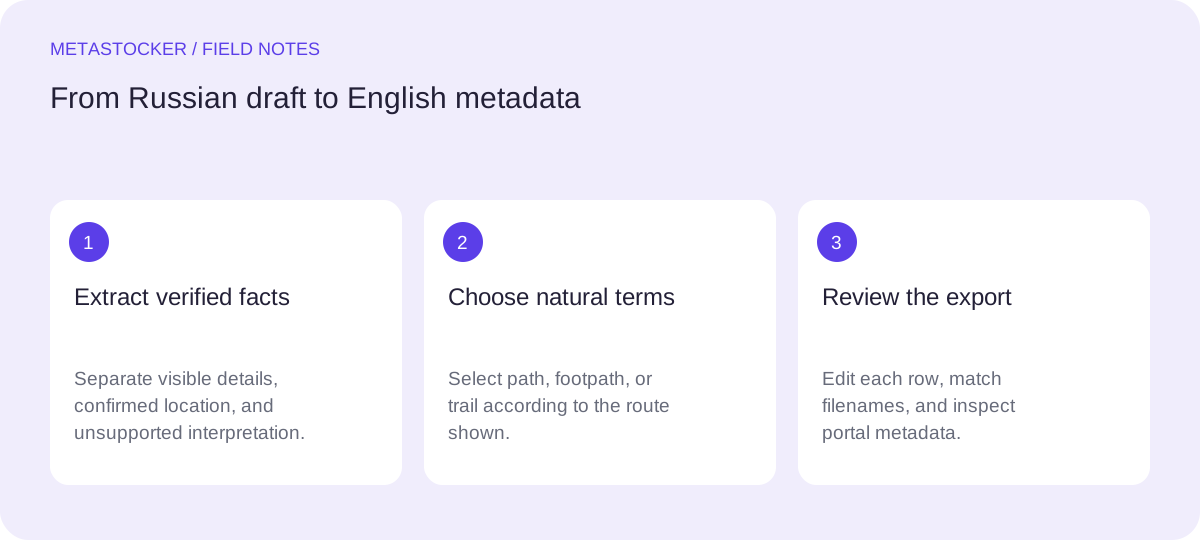
Separate visual facts from translation choices
Start by dividing the Russian draft into three groups: visible facts, verified context, and interpretation. Visible facts might include a wooded route, trees, ground cover, and daylight. Verified context might include Karelia, Russia, if the contributor knows and can support the location. Interpretation includes claims such as peaceful, remote, untouched, or ideal for hiking. These may sound attractive but should not be added unless the image or accompanying records justify them.
Do not infer a person, season, species, ownership, or exact location from pixels alone. If the Russian text says лесная дорожка, decide whether the image shows a pedestrian route, a wider dirt road, or merely a narrow opening between trees. That decision is more important than finding a literal equivalent.
Choose path, footpath, trail, or walk
Use path when the image shows a general route through the landscape and its use is not certain. Use footpath when it is clearly a narrow route intended for people on foot. Trail can work when the scene conveys a marked or established route, especially in hiking or nature contexts, but it may imply recreation more strongly than path. Walk usually describes the activity or experience, not the visible route itself, so it is rarely the best primary noun for a forest track.
Avoid adding road if vehicles cannot reasonably use it. Avoid hiking trail if there is no evidence that the route is intended for hiking. A natural English title can mention a forest path even when the Russian draft uses a diminutive such as тропинка; English stock metadata generally needs clarity more than emotional nuance.
Worked example: rebuild the English metadata
Example Russian draft: Лесная тропинка среди сосен в Карелии, Россия, мягкий дневной свет. Assume the contributor has verified the location and wants English metadata for a landscape photograph. The central subject is a pedestrian route through a pine forest. The location belongs in the title and keywords because it is known, not because the trees appear to identify the region.
A suitable title is “Forest footpath among pine trees in Karelia, Russia.” It is a sentence-like description rather than a keyword pile. If the route is wider or its use is uncertain, replace footpath with path: “Forest path among pine trees in Karelia, Russia.” Do not call it a hiking trail unless that fact is known. The keyword order should put the strongest concepts first, followed by useful context and visual details.
For Adobe Stock, keep the title within the current CSV title limit and use a conservative maximum of 49 keywords. For a Shutterstock submission, use English descriptive metadata and check the current contributor requirements, including the relevant category and keyword range. These are platform-specific checks, not a universal translation rule.
Title: Forest footpath among pine trees in Karelia, Russia
Keywords: forest footpath, pine forest, Karelia, Russia, woodland path, nature, trees, landscape, outdoors, countryside, daylight, travel, wilderness, scenic, rural, environment
Build keywords in natural English
Translate concepts, not individual words in isolation. лес means forest, but woodland may be a better choice when the image feels enclosed and temperate. сосны means pine trees or pine forest, depending on whether the trees or the setting is the main idea. мягкий дневной свет can become soft daylight if that quality is genuinely visible; it does not require poetic additions such as magical light.
Put the subject first, then location, setting, visual elements, and legitimate use cases. Remove duplicates and near-duplicates that do not add meaning. Do not mix Russian and English in one language list unless a specific platform or account configuration requires it. Platform language rules differ, so check the current contributor portal before uploading.
Use a local generator as a drafting assistant
MetaStocker can help create an initial English title and keyword list from a preview. Its local mode runs the selected vision model in the browser, so the inference happens on the visitor’s device. The first model download needs internet; loading a model into memory is separate from retaining downloaded browser files in cache. Local mode does not automatically fall back to a cloud model.
Give the batch description only facts that apply to every file. For a mixed folder, add file-specific context after generation and review each row. If the image is a video, inspect the full motion yourself because sampled previews cannot establish every detail. Edit the result before export; an exact keyword count does not prove that the words are accurate.
Prepare and inspect the platform file
If you use Adobe’s CSV workflow, upload the assets first. The filename, including extension and letter case, must match between the asset and CSV. After importing, inspect the resulting metadata in the contributor portal. A CSV exporter creates a file; it does not upload, submit, guarantee acceptance, or embed metadata into the original image.
Keep the English list specific to the image and platform. Recheck the current contributor rules because limits and fields can change. For a known location, retain the verified place name consistently. For an unknown location, use broader wording such as forest path rather than inventing a region.
Before you continue
- Identify the visible route before choosing path, footpath, trail, or walk.
- Keep only locations and contextual facts that are verified.
- Write a natural English title, not a list of keywords.
- Place the main subject and location near the beginning.
- Use one consistent metadata language for the submission.
- Remove duplicates, guesses, and irrelevant tags.
- Review every generated row before exporting.
- Check the current contributor portal rules and inspect imported metadata.
Sources and editorial approach
Prepared with AI assistance. Worked examples are illustrative. Automated checks do not replace checking the requirements of your stock platform. How these guides are made.