 MetaStocker
Portfolio SEO
How to Organize a Bilingual Photography Blog for SEO
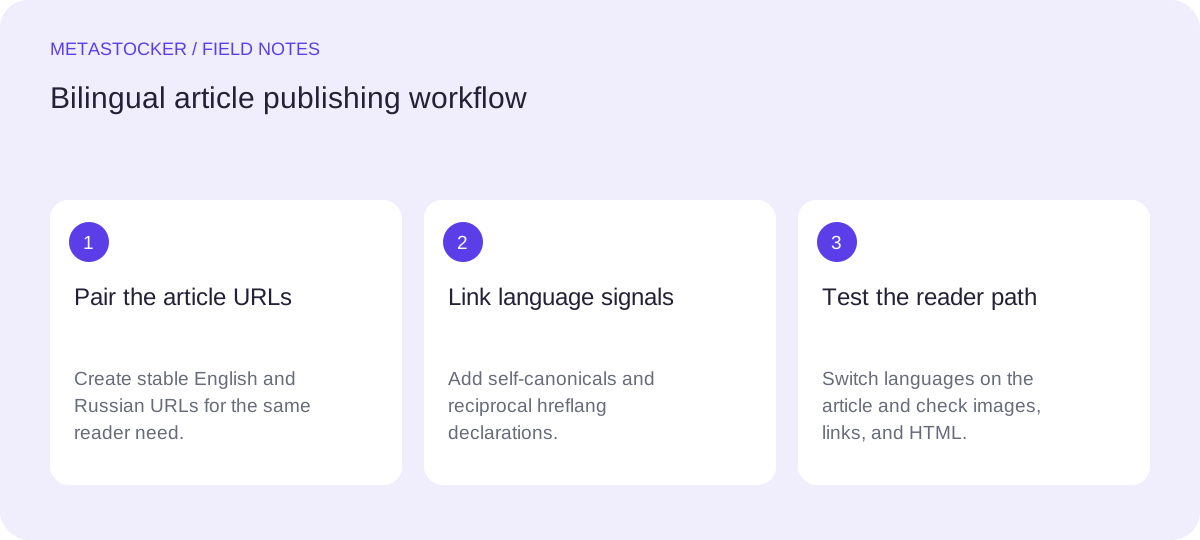
A bilingual photography blog works best when every article has two deliberate versions rather than one page that changes language unpredictably. Give the English and Russian editions separate, stable URLs; let each page identify itself as canonical; connect the translations with reciprocal hreflang; and make switching languages preserve the reader’s place in the article. This structure helps visitors choose the language they want while giving search engines clear localization signals. It does not guarantee indexing, traffic, or rankings, so the editorial quality of the photography guidance still matters most.
Choose a URL structure you can maintain
Select one consistent pattern before publishing several articles. Subdirectories such as /en/ and /ru/ are straightforward for a single domain, while language subdomains or separate domains require more operational care. The exact pattern matters less than consistency, readable slugs, and a one-to-one relationship between translations.
For example, an article about photographing fog on a river might use /en/foggy-river-photography/ and /ru/foggy-river-photography/. Keep the subject recognizable in both URLs, but do not force an awkward word-for-word translation. Avoid query parameters that merely alter visible language, because they make sharing, canonicalization, and switching harder to reason about.
- Use one permanent URL per language edition.
- Keep slugs short, descriptive, lowercase, and stable.
- Link translations directly to each other.
Write two useful editions, not duplicated pages
Translate the reader’s problem, not just every sentence. A Russian reader may need different examples, terminology, or explanations even when the article’s workflow is the same. Preserve the core promise, facts, and recommended actions, but rewrite introductions and examples so each version sounds natural.
For photography topics, explain what the reader should photograph, how to prepare, and how to evaluate the result. Avoid padding an article with repeated keyword variations. Helpful, original content has no magic word count, and a longer translation is not automatically a better page.
- Keep the main intent aligned across languages.
- Adapt examples and phrasing to natural reader expectations.
- Do not publish an unfinished translation solely to create another URL.
Set self-canonical URLs on both pages
The English page should have a canonical pointing to its own absolute English URL. The Russian page should do the same for its Russian URL. A canonical tells search engines which URL represents that particular page; it should not be used to collapse legitimate translations into one language edition.
Check that canonicals use the final HTTPS address, the intended host, and the preferred trailing-slash style. Also check that neither language page accidentally canonicalizes to the other. Canonicals and hreflang serve different purposes: one identifies the preferred URL for a page, while the other describes equivalent localized alternatives.
- Use an absolute self-canonical on every translated article.
- Keep canonical and visible URL conventions consistent.
- Review rendered HTML, not only your content-management-screen settings.
Connect translations with reciprocal hreflang
Each edition should declare both language alternatives, using the exact URL of each page. The English page can reference en and ru; the Russian page should reference ru and en. Include an x-default only when you have a meaningful neutral landing page or language-choice page. Do not invent a fallback that immediately redirects visitors by IP.
Reciprocity is important: if English points to Russian, Russian should point back to English. Use the same language identifiers consistently and verify spelling, protocol, host, and path. Hreflang is a signal for localized versions, not a promise that Google will crawl, index, or display the chosen version for every query.
- Make every language reference return a reachable page.
- Use matching hreflang declarations in both editions.
- Treat x-default as optional, not as an automatic redirect target.
Design a language switch that preserves context
Place an English/Russian switch near the article title or in a persistent header. The link should point to the corresponding translation of the current article, not to the blog homepage. If a translation does not exist, say so clearly and offer the closest useful destination rather than silently changing language.
Do not redirect by IP address. A traveler, bilingual reader, search crawler, or shared-device user may not want the language inferred from network location. A visible switch gives people control and makes the selected URL shareable. Keep navigation labels understandable, such as “English” and “Русский,” even when the current article body is long.
- Preserve the article slug relationship when switching.
- Let users switch manually at any time.
- Keep the selected language in the URL, not only in a cookie.
Apply image and technical checks to a real article
Consider this hypothetical article: “Photographing a Foggy River at Dawn.” The English edition explains how to protect highlights, focus before contrast drops, and describe the scene without inventing a location. The Russian edition covers the same decisions in natural Russian and links back to the matching English page.
Before publishing, inspect the two pages as a reader. Confirm that each has a self-canonical, reciprocal hreflang, descriptive surrounding text, and useful alt text for meaningful images. If you use a sitemap, include the canonical absolute URLs; a sitemap can help discovery but cannot guarantee crawling or indexing. Remember that website image alt text and stock-marketplace keyword metadata are separate systems.
- Compare the two editions for intent and factual consistency.
- Use alt text that describes the image’s purpose or content.
- Test the switch from both language pages and on mobile.
- Check the contributor or search platform’s current guidance when requirements change.
Hypothetical publication check:
English: /en/foggy-river-photography/
Russian: /ru/foggy-river-photography/
English canonical: its own English URL
Russian canonical: its own Russian URL
Both pages: hreflang en ↔ ru
Switch: current article in the other language
Before you continue
- Choose a stable URL pattern for English and Russian.
- Publish genuinely useful, natural editions with the same search intent.
- Add a self-canonical to each language URL.
- Add reciprocal hreflang with exact absolute URLs.
- Make the switch open the matching article, never an IP-based redirect.
- Use descriptive image context and alt text.
- Test links, canonicals, and language signals after deployment.
- Review current search-engine guidance when your setup changes.
Sources and editorial approach
Prepared with AI assistance. Worked examples are illustrative. Automated checks do not replace checking the requirements of your stock platform. How these guides are made.